Platform
Components, vulnerabilities and hardening from your firmware
LegacyMind reads from a firmware image or build which components at which version are inside, which known vulnerabilities attach to them, which credentials and keys ship with it and which protection mechanisms are missing. Back come an SBOM in CycloneDX or SPDX and two reports with findings against CRA Annex I and § 30 BSIG (Germany's NIS2 implementation). No source code needed.
As of 20 October 2026
How it works
From upload to monitoring in four steps
01
Upload
Provide a firmware image, a supplier SBOM (CycloneDX, SPDX) or a bare-metal build (ELF, for example from Keil) by upload, or read it out of the target environment with the Extractor (closed beta)02
Analysis
Specialised analyses assess components, vulnerabilities, hardening and compliance in parallel03
Report
SBOM, technical findings, compliance mapping and risk assessment in one report04
Monitoring
New CVEs and KEV entries keep being matched to the analysed releases
Per file
What comes back from which file
How much the analysis finds depends on what the file carries. A build with debug information names libraries and versions; a raw image only what its bytes evidence. Every file extension is listed under formats.
.zip .tar .gz .tgz
Firmware images with Linux
The image as you ship it: archives, raw images, file systems (SquashFS, JFFS2, CramFS, UBI, YAFFS2, ext), kernel and boot images including ARM zImage, update containers and VM disks. The analysis unpacks down to the root file system and finds the packages of Debian, OpenWrt, Alpine and Red Hat based systems, the programs and the kernel, each with its version.Components, versions, vulnerabilities.elf .axf .out
Bare-metal builds (ELF, AXF)
Microcontroller builds from Keil MDK, IAR or GNU Arm. It finds the libraries built in, with their versions, for example CMSIS packs, RTX5, FreeRTOS, lwIP, mbedTLS and STM32Cube. Plus hardening (stack canary, MPU, privilege separation) and embedded keys.Components, versions, vulnerabilities.bin
Raw microcontroller images (BIN)
A BIN without a file system. When the AXF of the same build is there, the BIN gets its components with their versions. On its own it names the components the image itself evidences, for example TLS libraries.Components, as far as the bytes evidence them.hex .ihex .s19 .srec
Intel HEX and Motorola S-record
Converted to bytes and analysed like the BIN of the same build. When the AXF is there, they get its components with their versions.Components, as far as the bytes evidence them.json .xml .spdx
Supplier SBOMs
Your suppliers' SBOMs in CycloneDX (JSON, XML) or SPDX (JSON, tag-value, SPDX 3.0 JSON-LD), up to 64 MB. We detect the format from the content. Every component with a CPE, distribution or repository identifier is matched against the vulnerability sources. Matching for npm, PyPI and Maven packages follows.
01 / 05
Overview per device
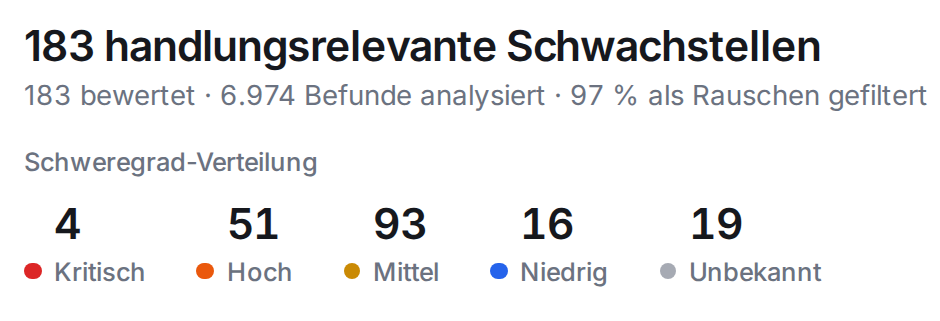
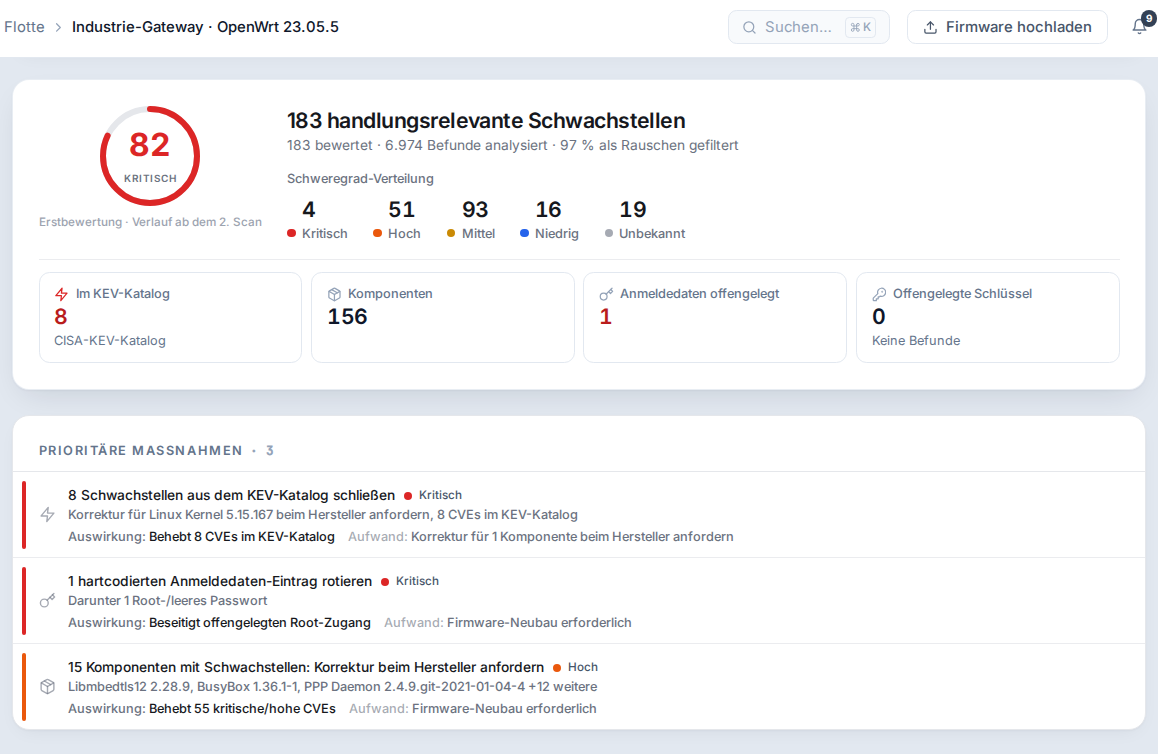
One device, one page: the risk score, the actions in their order, and the findings on CRA Annex I and § 30 BSIG.
- Risk score from the technical findings and evidenced exploitation
- Actions in the order to work through them, each with the affected component
- Findings on CRA Annex I and § 30 BSIG in one view
- New CVEs and KEV entries for releases already analysed
02 / 05
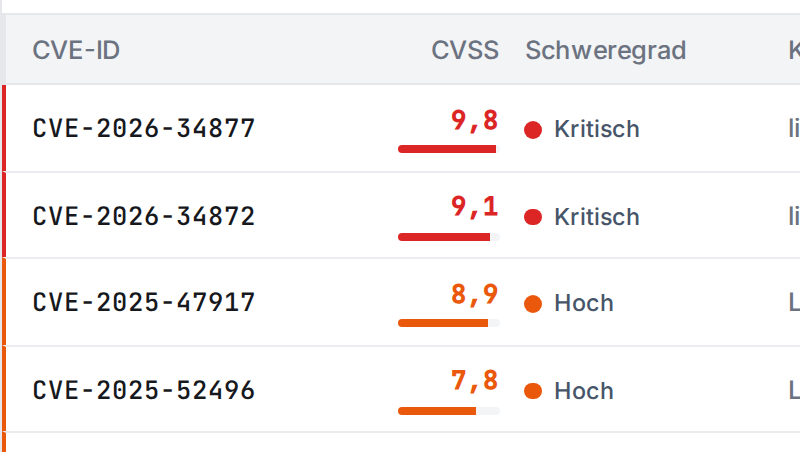
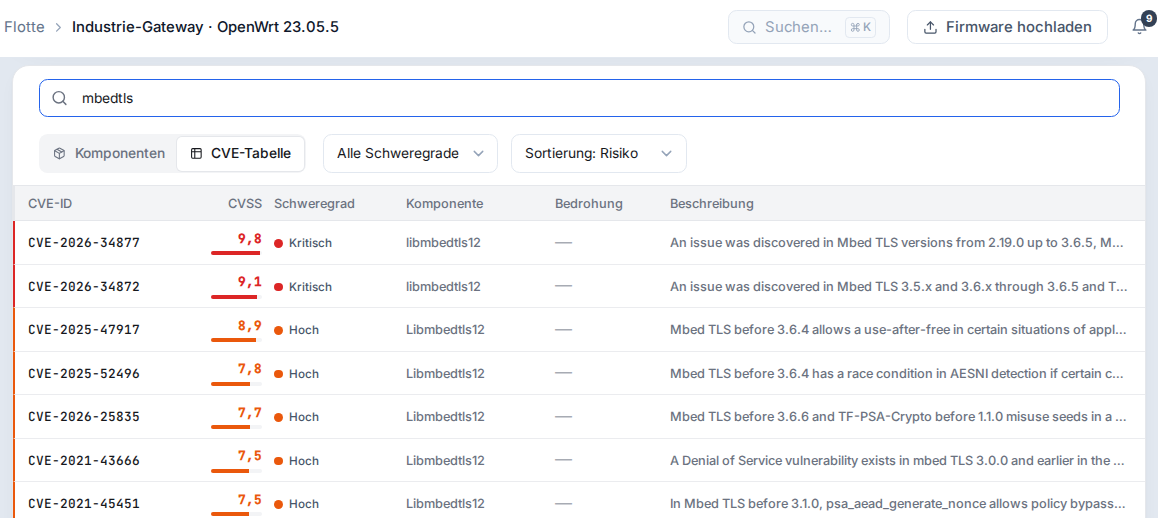
Vulnerability analysis
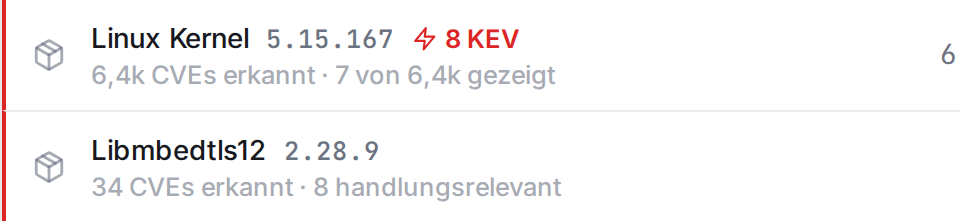
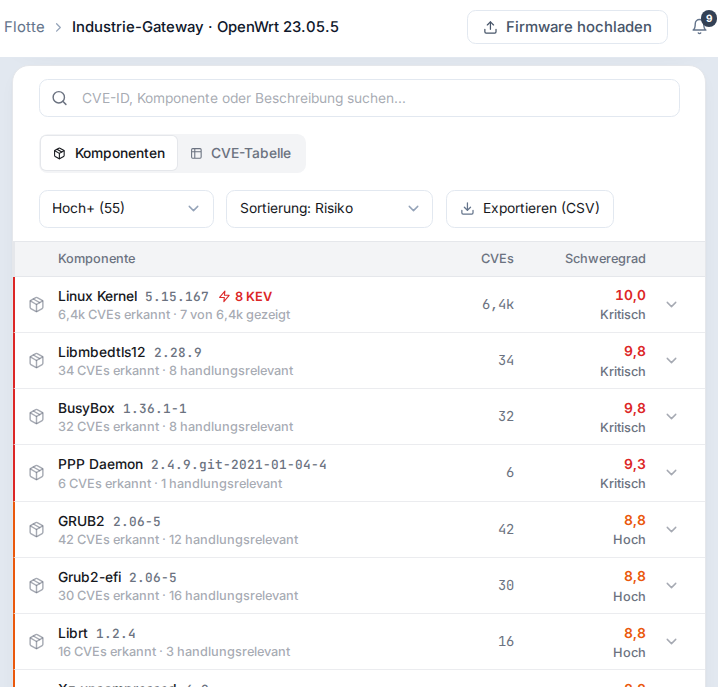
What is actively exploited sits at the top. CVSS alone does not decide the order.
- Matched against 18 public sources, CISA KEV and EUVD among them
- Findings grouped by affected component, with version and source on every row
- Every match notes whether the version is confirmed or assumed
- CVE details with the version that closes the finding
18sources
Distributions, vendor CSAF advisories, authorities and the open-source ecosystem, plus CISA KEV and EUVD for actively exploited vulnerabilities.
Distributions
- Alpine secdbAlpine Linux
- Debian Security TrackerDebian
- Red Hat CSAF-VEXRed Hat
- Red Hat Security Data APIRed Hat
- Ubuntu CVE TrackerCanonical
Vendor CSAF
- CERT@VDE, Phoenix ContactCERT@VDE
- KUNBUS PSIRTKUNBUS
- Red Hat Product SecurityRed Hat
- SICK PSIRTSICK
- Siemens ProductCERTSiemens
Government agencies
Ecosystem
- GitHub Advisory DatabaseGitHub
- kernel.org vulns.gitLinux kernel CNA
- OSV.devOpenSSF
03 / 05
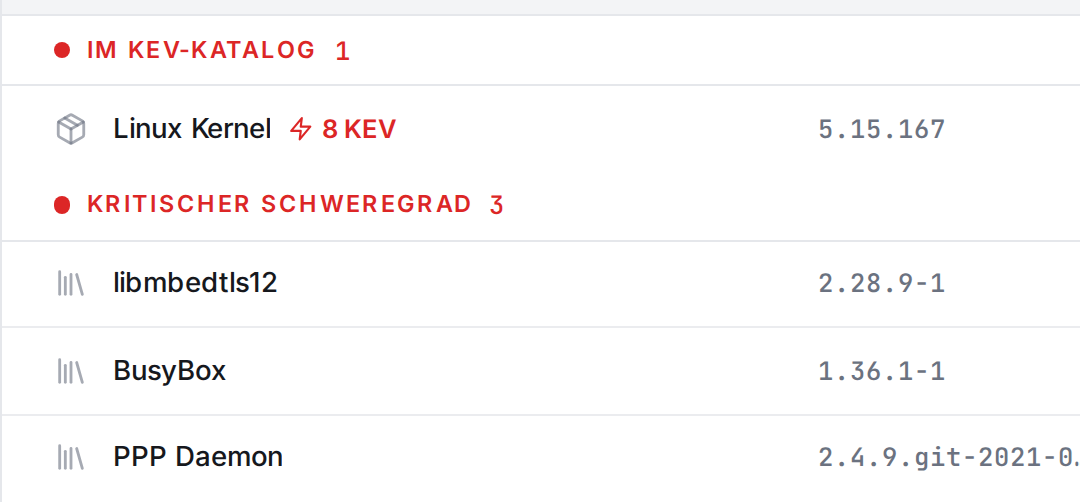
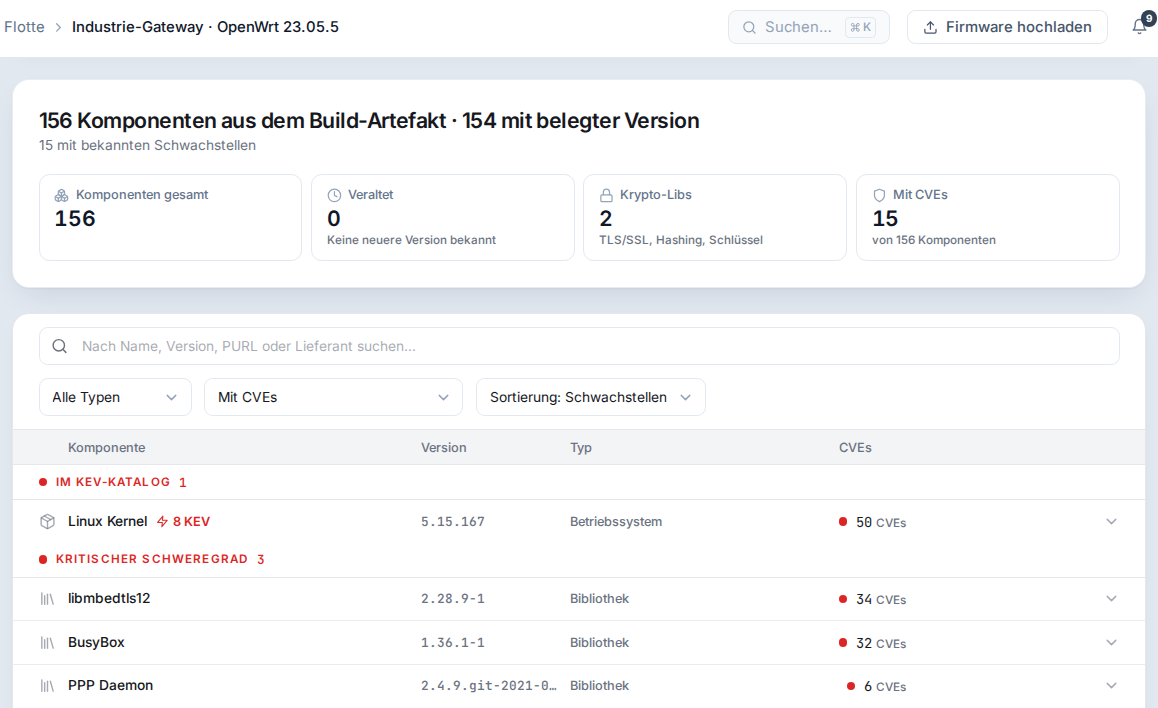
Components and SBOM
SBOM generation straight from binary firmware, without source code.
- CycloneDX export, machine-readable
- Crypto inventory, assessed against BSI TR-02102-1
- Per component: name, version and where in the image it was found
- A version without evidence in the image stays blank. It is never guessed.
04 / 05
Hardening analysis
What sits in the image and should not: credentials, keys, unprotected binaries.
- Accounts with an empty or weak password, the hash algorithm per account
- Certificates with expiry date, key length and self-signing
- Linux: RELRO, NX, PIE and stack canaries, binary by binary
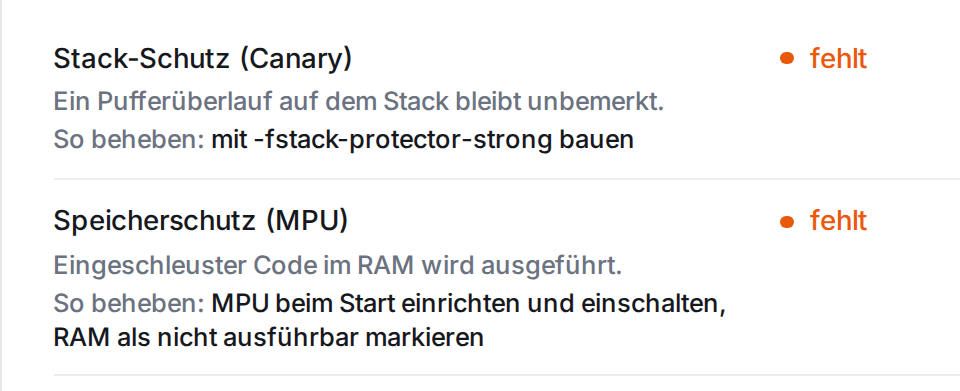
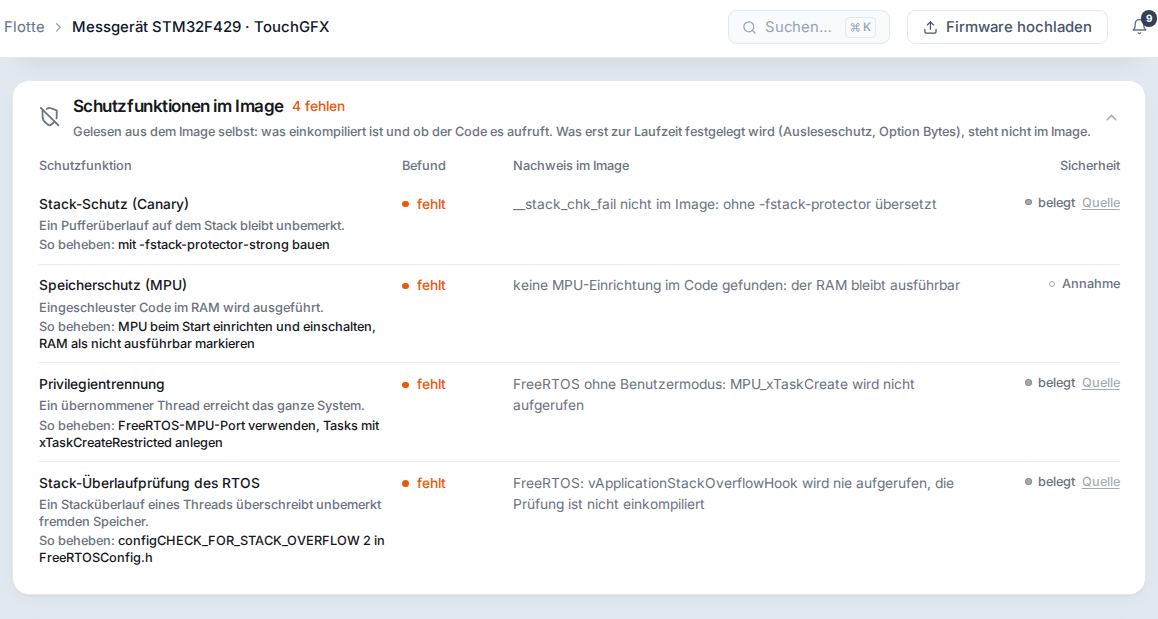
- Microcontrollers: stack canary, MPU and privilege separation, measured on the build
- Binaries and builds that pull in unsafe C functions such as strcpy, sprintf or gets
05 / 05
CRA Annex I and § 30 BSIG
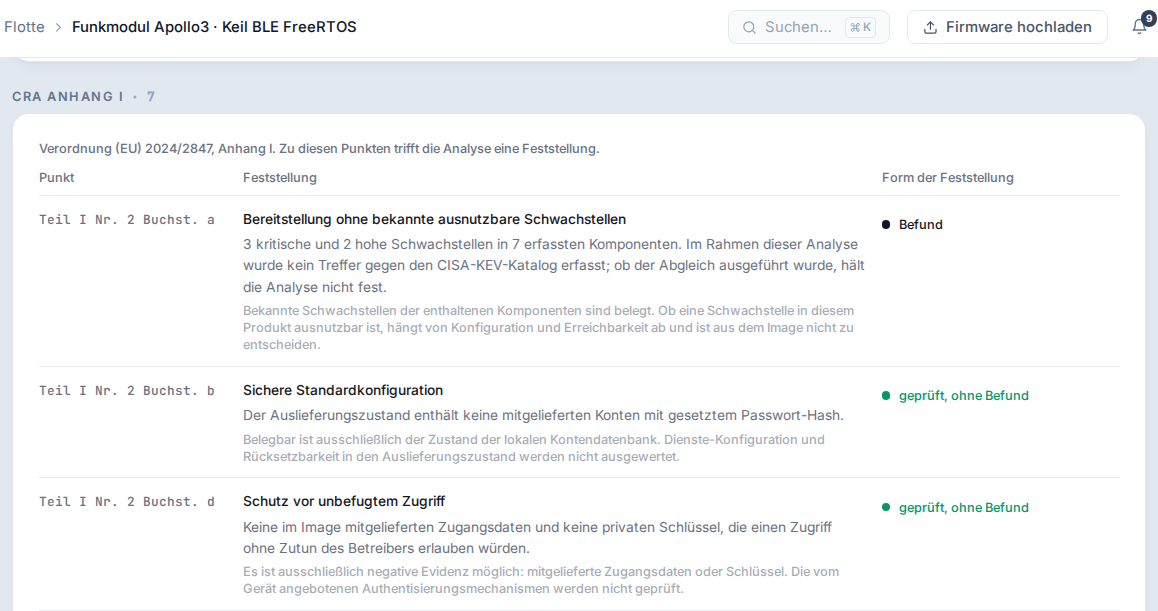
The findings of an image, mapped to the requirements, each point with its basis.
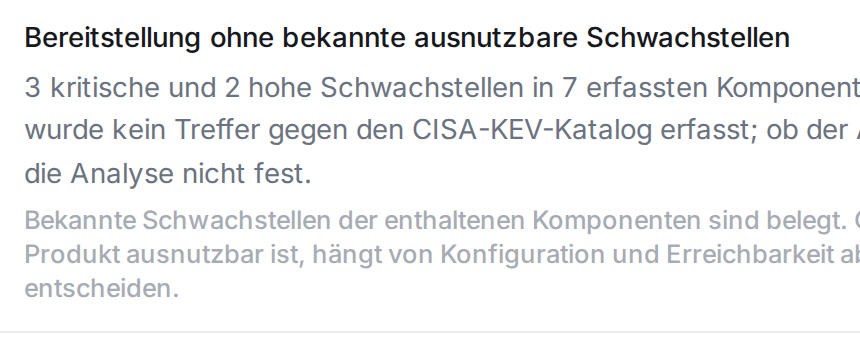
- CRA Annex I: the analysis answers 5 requirements from the image and gives counts for 1; the report lists 16 by number for your documentation
- § 30 BSIG: the analysis answers 2 items from the image and gives counts for 1; the report lists 7 by number as actions for the entity itself
- A manufacturer gets CRA Annex I by part and letter, an operator § 30(2) sentence 2 BSIG by number, from the same analysis and the same figures
- Each point takes one of five forms: finding, checked with no finding, not checked with a reason, observation, not determinable from the image
Continuous monitoring
Analyse once. Keep the risks in view.
A scan shows today's state. After that, LegacyMind keeps matching newly published CVEs to the same firmware releases, and the risk score follows.
- 2hours
- KEV and EUVD matching, every 2 hoursCatalogues of actively exploited vulnerabilities, against every release already analysed
- 24hours
- CVE matching, once a dayNew vulnerabilities are matched to firmware releases already analysed
Risk updates on every run. The risk score is computed from the findings.
The report
What the technical findings report contains
The table of contents of the real report on a public Keil build. The report is in German. Sections that do not apply to an image are not printed.
- Geltungsbereich und Prüfgegenstand3
- Management-Kurzfassung4
- 6Komponenten-Schwachstellenkatalog9
- 12Abdeckung, Grenzen und Erklärung zum Prüfumfang13
- 14Maßnahmenplan je Befund (Release-Planung)15
- 15Normbezug: CRA Anhang I16
All 20 sections
- Geltungsbereich und Prüfgegenstand3
- Management-Kurzfassung4
- 1Technische Einordnung5
- 2Methodik und Prüfgrundlage6
- 3Priorisierung: vom Rohbefund zur Handlung7
- 4Angriffsfläche und Exposition · not printed for this build
- 5Vorrangig zu behandelnde Befunde8
- 6Komponenten-Schwachstellenkatalog9
- 7Anmeldedaten und Geheimnisse10
- 8Speicherschutz und Exploit-Schutzmaßnahmen10
- 9Kernel-Härtung und Kernel-Exposition · not printed for this build
- 10Weitere statische Prüfungen10
- 11Software-Stückliste (SBOM) und Begleitdokumente11
- 12Abdeckung, Grenzen und Erklärung zum Prüfumfang13
- 13Befundliste zur Nachverfolgung14
- 14Maßnahmenplan je Befund (Release-Planung)15
- 15Normbezug: CRA Anhang I16
- AGlossar und Abkürzungsverzeichnis17
- BReferenzen und Normenverzeichnis18
- CBerichtsnachweis und Dokumentenlenkung18
Outputs
What you export and pass on
The SBOM for your technical documentation, the reports for management and engineering, the vulnerabilities as CSV for your ticket system.
SBOM export
CycloneDX 1.6 JSON, SPDX 2.3 and SPDX 3.0.1 JSON, plus CSV. Every component says where in the image it was read.Vulnerabilities
Matched against 18 public sources, CISA KEV and EUVD among them. Supplier SBOMs are matched against 14 of these 18: your suppliers' component names go to no public query API.A decision per finding
A CERT/CC SSVC decision for every vulnerability found, with the inputs it follows from.Two reports
A management summary and a technical findings report, both in German, with findings against EU CRA Annex I and § 30 BSIG.
Not yet: VEX and CSAF export, Firmware Extractor (closed beta).
Questions about the platform
What developers and buyers ask
Do you need source code?
No. The analysis runs on the firmware image you ship, or on the file your build produces.
Which formats do I get the SBOM in?
CycloneDX 1.6 JSON, SPDX 2.3 JSON and SPDX 3.0.1 JSON, plus CSV. Every component names the place in the image where it was read.
What happens if a version is not in the file?
Then the field stays blank, and the component stays on the list. A version is never guessed, because a guessed version leads to wrong vulnerabilities.
How often are new vulnerabilities matched?
The catalogues of actively exploited vulnerabilities, CISA KEV and EUVD, every two hours. New CVEs daily, against every release already analysed.
How is the order of the findings decided?
By rules, and traceably: actively exploited vulnerabilities (CISA KEV) first, then by need for action and severity. Every vulnerability gets a CERT/CC SSVC decision, with the inputs it follows from.
Does the report replace a conformity assessment?
No. It provides technical evidence on the points a firmware can evidence. You make the conformity statement, as a manufacturer under the CRA or as an entity under § 30 BSIG.
See it on your own firmware
In the free CRA readiness check we analyse one file from your build or your shipped image.