LegacyMind GmbH · Ingolstadt, Germany
Firmware analysis for industrial and IoT devices
Upload a firmware image or a microcontroller build. LegacyMind reads it at the binary level, without source code and without an agent on the device: which components are inside, which known vulnerabilities match them, and where hardening is missing.
Cyber Resilience Act
The reporting duty applies. It covers the device in the field.
Your build says what should go into the device. The shipped image says what is in it. Between the two sit your suppliers' libraries, and they are in no bill of materials you wrote yourself.
Free firmware checkOne shipped image, one verifiable findings report. No source code and no access to the device.
Report what has shipped
An actively exploited vulnerability in your product: early warning within 24 hours, notification within 72 hours, final report within 14 days after a corrective or mitigating measure is available. The deadlines apply to the device in the field.
The bill of materials per release
Identify and document the product's components and vulnerabilities, including a software bill of materials. A separate one for every version the customer receives.
Source: Regulation (EU) 2024/2847
From the shipped image
The bill of materials Annex I asks for
Every component found, with name, version and the place in the image where it sits. Export as CycloneDX 1.6.
What could not be read is listed with the reason. A version without evidence stays blank.
Komponenten
119 von 119 Paketen erkannt, Version exakt · 3 mit geprüftem Befund · 1 mit aktiv ausgenutzten Schwachstellen (KEV)
- 1mit KEV
- 1Kritisch
- 1Hoch
- 0Mittel
- 0Niedrig
- 116ohne geprüften Befund
Beschreibung
Linux-Kernel: Speicherverwaltung, Prozess-Scheduling, Netzwerk, Gerätetreiber und Systemaufrufe
Sicherheitskontext
3 Schwachstellen werden laut CISA-KEV-Katalog aktiv ausgenutzt, jede in Code, der in diesem Image gebaut ist. CVE-2024-36971: Im Linux-Kernel hält die Funktion __dst_negative_advice() die RCU-Regeln beim Leeren des Routen-Caches eines Sockets nicht ein, was zu einem Use-after-free führen kann. CVE-2025-38352: Im Linux-Kernel besteht eine Race Condition zwischen handle_posix_cpu_timers() und posix_cpu_timer_del(), wenn ein beendeter Prozess bereits abgeräumt wird, während sein CPU-Timer noch verarbeitet wird. CVE-2024-50302: Im Linux-Kernel wird der Berichtspuffer des HID-Kerns nicht mit Nullen initialisiert, sodass ein präparierter HID-Bericht Kernelspeicher preisgeben kann.
Schwachstellen
- 3 CVEs
- 2Hoch
- 1Mittel
davon 3 aktiv ausgenutzt (CISA KEV)
Im Tab „Schwachstellen“ anzeigen- Version
- 5.4.238
- Empfohlen ab
- 5.4.295
- Hersteller
- The Linux FoundationAdvisory
- Lizenz
- GPL-2.0
- Package URL
- pkg:
generic/ linux-kernel@5.4.238 - CPE
- cpe:
2.3: o: linux: linux_kernel: 5.4.238: *: *: *: *: *: *: *
33 von 119 Komponenten gezeigt, sortiert nach Befunden. 116 ohne geprüften Befund in diesem Auszug.
SBOM exportieren
Erkanntes Komponenteninventar in Standardformaten
Input
What it reads
Firmware images with Linux
The image as you ship it: archives, raw images, file systems (SquashFS, JFFS2, CramFS, UBI, YAFFS2, ext), kernel and boot images including ARM zImage, update containers and VM disks. The analysis unpacks down to the root file system and finds the packages of Debian, OpenWrt, Alpine and Red Hat based systems, the programs and the kernel, each with its version.Bare-metal builds (ELF, AXF)
Microcontroller builds from Keil MDK, IAR or GNU Arm. It finds the libraries built in, with their versions, for example CMSIS packs, RTX5, FreeRTOS, lwIP, mbedTLS and STM32Cube. Plus hardening (stack canary, MPU, privilege separation) and embedded keys.Raw microcontroller images (BIN)
A BIN without a file system. When the AXF of the same build is there, the BIN gets its components with their versions. On its own it names the components the image itself evidences, for example TLS libraries.Windows CE images
It finds the modules in the ROM and the programs, each with its version.Intel HEX and Motorola S-record
Converted to bytes and analysed like the BIN of the same build. When the AXF is there, they get its components with their versions.Supplier SBOMs
Your suppliers' SBOMs in CycloneDX (JSON, XML) or SPDX (JSON, tag-value, SPDX 3.0 JSON-LD), up to 64 MB. We detect the format from the content. Every component with a CPE, distribution or repository identifier is matched against the vulnerability sources. Matching for npm, PyPI and Maven packages follows.
Every format, tier by tier: file extensions, what each one yields, and what comes next.
The report
What an auditor finds in the report
The technical findings report names the image with its SHA-256, the time and the scope before the first finding. Four places from it, drawn as they appear in the report, which is written in German.
- CheckedThe checks that ran on this image, by name.
- With limitationBinary hardening: on stripped binaries the canary cannot be determined.
- Not assessedA step that could not run on this image, such as the kernel configuration without kconfig.
- Catalogue data dateThe date of the local CVE database. For the other sources the analysis records no date, and the report says exactly that.
Four lines before the sign-off. A missing finding never turns into an all-clear.
Match of component and version
Threshold: CVSS 7.0 or higher
Signal: listed in the CISA KEV catalogue
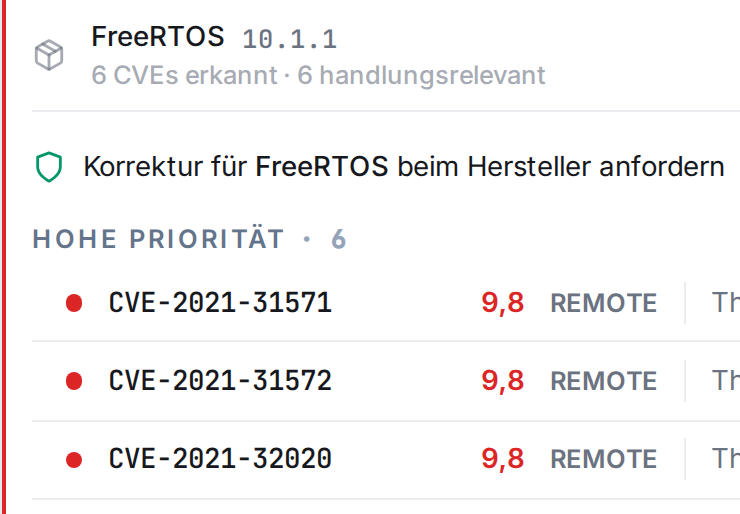
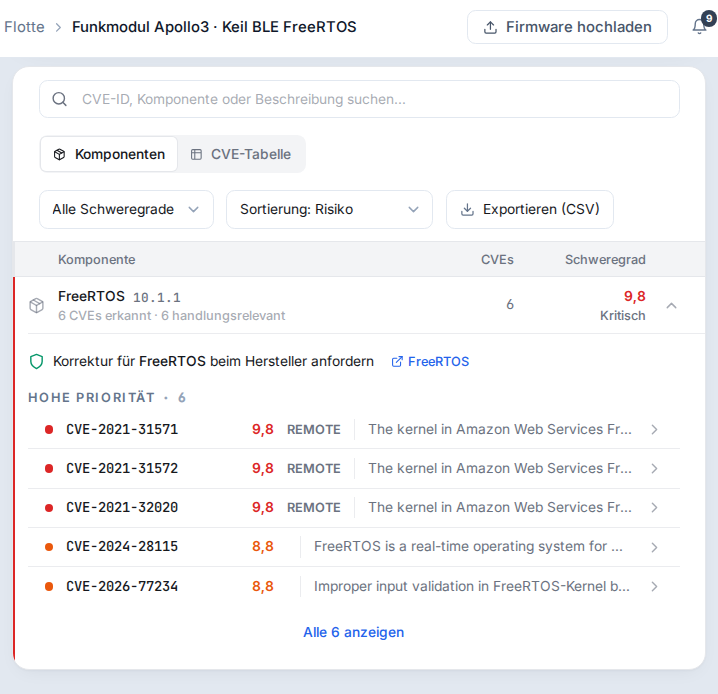
Of 6 reported vulnerabilities none is in the KEV catalogue; 5 are high or critical.
Public Keil example project ble_freertos_amota.axf, CVSS as in the report. Checked against the build's symbol table for this example: 2 of the 6 have code in the build.
| Binary | RELRO | Canary | NX | PIE |
|---|---|---|---|---|
| not stripped | ||||
| stripped |
- determinable
- with limitation, counted as missing to be safe
Four checks per executable file, in the report with the number of binaries checked. On stripped files the canary cannot be determined and counts as missing. The scope statement says so.
- Distribution trackersSecurity notices of the Linux distributions
- Vendor CSAFSecurity advisories from vendors and authorities
- Public databasesVulnerability databases, including the Linux kernel's
- Exploitation signalCatalogues of actively exploited vulnerabilities
The matching behind the catalogue runs against 18 sources. The report calls the CVE set a version-based indication, because vendor backports cannot be checked publicly.
Data from the GitHub Advisory Database and OSV under CC BY 4.0.
Output
What you get
Answers to the questions buyers ask most, with sources, are under knowledge.
SBOM
CycloneDX 1.6, SPDX 2.3 or SPDX 3.0.1. For every component it detects: the name, where in the image it sits, and the version where the image proves it.Known vulnerabilities
Matched against 18 public sources, CISA KEV and EUVD among them. Actively exploited vulnerabilities come first; CVSS orders the rest.Confirmed or assumed
Every match says whether the version is confirmed in the image or assumed.Secrets
Credentials, private keys, certificates and password hashes in the image.Hardening
RELRO, NX, PIE and stack canaries per binary, and on microcontroller builds the missing protection mechanisms.CRA and NIS2 findings
Findings against EU CRA Annex I and § 30 BSIG, Germany's NIS2 law. No percentage, no conformity verdict: you make the conformity statement.
Customers
Who it is for
01
Device manufacturers
Keil, IAR and Linux firmware, preparing for the EU Cyber Resilience Act.02
Operators under NIS2
Entities under § 30 BSIG, critical facilities included.03
Managed service providers
Looking after devices for their customers.
Compliance
Security requirements, assessed and documented point by point
No questionnaire. The basis is the shipped image, and two runs over the same image give the same lines. The analysis maps every finding to the 32 points of CRA Annex I and § 30 BSIG, with the same evidence. A statement takes one of five forms: finding, checked without finding, not checked with a reason, observation, not determinable from the image.
The compliance tab counts statements. A line reads like this: six findings in ten points checked. A percentage would have to score a point that was not checked as half a point. So the tab prints counts, not a conformity verdict.
What the method cannot check is stated as such in the report: processes, training and reporting channels cannot be determined from a firmware image. A point that cannot be measured on the image never turns green.
Every point in detailRead the law
11 Sep 2026 · 11 Dec 2027
CRA Annex I
Regulation (EU) 2024/2847: reporting obligations since September 2026, full manufacturer obligations from December 2027. From the image, the analysis answers 5 requirements and gives a count for 1; the report lists the remaining 16 by number, mapped to the manufacturer's technical documentation.
6 Dec 2025
§ 30 BSIG
Risk management measures under § 30(2) sentence 2 BSIG, Germany's NIS2 law. From the image, the analysis answers 2 items and gives a count for 1; the report lists the remaining 7 by number, as measures of the entity. In the operator report it is structured for evidence under § 39 BSIG.
Company
LegacyMind GmbH
LegacyMind analyses industrial and IoT firmware at the binary level: SBOM, known vulnerabilities, credentials, hardening, and findings against CRA Annex I.
- Company
- LegacyMind GmbH
- Location
- Ingolstadt, Germany
- Register
- Amtsgericht Ingolstadt, HRB 12510
- Management
- Ben Plannet, CTO. Marco Plannet, Managing Director.
- Engine
- Developed in-house: the analysis, the scoring and the CVE matching.
- Your file
- Analysed on our servers in Germany, database and storage in Frankfurt. Only component names and versions go out, to match public vulnerability sources. The file is deleted after the analysis.
Knowledge
Answers for firmware teams
Guides
.axf .bin .hex · 5 min read
Checking Keil firmware for known vulnerabilities
Why the AXF beats the BIN, and how to read libraries and versions from the build.
.out .map · 4 min read
IAR firmware SBOM: reading components from the .out
Toolchain, linked libraries and versions from an IAR build, on a public STM32 project with FreeRTOS and FreeRTOS+TCP.
CycloneDX SPDX · 4 min read
Checking supplier SBOMs
Validity, the fields BSI TR-03183-2 requires, vulnerabilities, and the comparison with the image.
Vulnerabilities by version
| Library | Versions on the page | |
|---|---|---|
| BusyBox | 1.24 to 1.38 | |
| dnsmasq | 2.77 to 2.93 | |
| Dropbear | 2020.81 to 2026.94 | |
| ESP-IDF | 4.4 to 6.1 | |
| FatFs | R0.11 to R0.16 | |
| FreeRTOS | 10.x and 11.x, +TCP | |
| Linux-Kernel | LTS 4.14 to 6.18 | |
| lwIP | 1.4.1 to 2.2.1 | |
| mbedTLS | 2.16 to 4.x | |
| MCUboot | 1.7 to 2.5 | |
| NimBLE | 1.4 to 1.10 | |
| OpenSSL | 1.0.2 to 4.1 | |
| STM32Cube | lwIP, mbedTLS, FreeRTOS | |
| ThreadX, NetX Duo | 6.1 to 6.5 | |
| U-Boot | 2020.04 to 2026.10 | |
| wolfSSL | 3.15 to 5.9 | |
| Zephyr | 3.7 to 4.4 |
Questions
Frequently asked questions
Guides with commands to follow are under knowledge, the path of your file under security.
01What does the method not cover?
Runtime and penetration analysis, source code audit, hardware and side-channel analysis, organisational processes. The analysis does not measure whether a service is reachable on the network. This is on the first page of every report under „Nicht im Geltungsbereich“ (out of scope), so an auditor knows the boundary before reading the first finding.
02Which firmware formats does LegacyMind support?
Firmware images with Linux, bare-metal microcontroller builds (ELF and AXF, for example from Keil, IAR or GNU Arm) and your suppliers' SBOMs in CycloneDX or SPDX. Linux images also as archives and file-system extracts of common distributions such as OpenWrt, DD-WRT or Buildroot. The list by file extension is under supported formats (/en/formats). Extraction directly from the device with the Extractor is in closed beta.
03Where do the CVE matches come from?
From 18 public sources: security notices of the Linux distributions, security advisories from vendors and authorities, vulnerability databases and the catalogues of actively exploited vulnerabilities. What a distribution lists as fixed for its package is not reported as open. Data from the GitHub Advisory Database and OSV under CC BY 4.0.
04Which requirements does the report map findings to?
To the requirements of Annex I of Regulation (EU) 2024/2847 (CRA) and the risk management measures under § 30(2) sentence 2 BSIG. Every point carries a statement in one of five forms: finding, checked without finding, not checked (with a reason), observation, not determinable from the image. No percentage, no conformity verdict.
05Where is data processed, and what happens to the firmware?
The analysis runs on our servers in Germany; database and storage are in Frankfurt. Only component name and version go out, to match the vulnerability sources. The firmware file is deleted after the analysis. Your account keeps the results: components, vulnerabilities, risk rating. Retention periods can be set per account.
06Can I integrate LegacyMind into existing workflows?
Yes. Reports as PDF, the SBOM as CycloneDX or SPDX for supply-chain tools, and the Firmware Extractor for extraction over SSH (closed beta). API access for CI/CD integration is on the roadmap.
Write to us in English
The app and the reports are in German. Questions in English are welcome. The free firmware check covers one file: report and SBOM within three working days, NDA on request.